

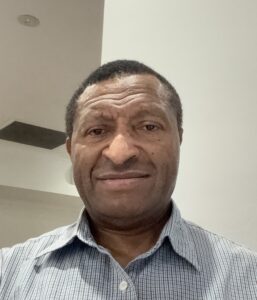
As ASHM’s work in Papua New Guinea (PNG) continues to expand, it has become increasingly important to have somebody on the ground to lead the delivery of our health system strengthening work, with a particular focus on HIV and triple elimination. As such, this year ASHM welcomed Dr Percy Pokeya as the inaugural PNG Country Lead. Dr Pokeya will be overseeing a number of ASHM-led projects in the country, including the Supporting Triple Elimination in Papua New Guinea and Timor-Leste (STEPT) project as well as supporting the Sexual and Reproductive Health Integration Project (SRHIP).
Below, Dr Pokeya speaks about his career to-date, and the projects he will be leading in this new position.
Can you explain your journey into the HIV sector and what led you to your current role?
My journey into HIV medicine began in 2008 while I was working for an oil company, then Oil Search Limited, now Santos Limited, operating in some of the most remote parts of PNG. As landowner royalties and wages increased, we began to see HIV cases emerging among local communities and workers. For me, this work became deeply personal following one defining experience.
While working as a rig medic on a remote drilling site high in the mountains of the Southern Highlands, I cared for a young man who tested positive for HIV. We were completely isolated, with no access to antiretroviral treatment, and at the time I did not have the training or skills to properly support him. As his fear deepened and he became suicidal, it became clear that we were unprepared to respond to HIV in these settings. That moment fundamentally changed the direction of my career.
In response, the company recognised the urgent need to act. I was trained to prescribe antiretroviral therapy and manage HIV care, and HIV treatment services were introduced within the company and surrounding communities where the PNG LNG Project operates, including Hela, Southern Highlands, and Gulf provinces. This marked the beginning of my transition from clinical care into broader public health work.
From there, my work expanded into national HIV programming, where over the last 18 years, I worked across initiatives supported by the Asian Development Bank, the Global Fund, and the U.S. President’s Emergency Plan for AIDS Relief (PEPFAR), whilst engaged through the Santos Foundation, the U.S. Centers for Disease Control and Prevention (CDC), the U.S. Agency for International Development (USAID), and the U.S. Department of State.
Throughout this period, I worked closely with PNG’s National Department of Health as a technical expert, supporting the introduction of optimal HIV treatment regimens and viral load testing to strengthen treatment monitoring nationwide. During my time working with the U.S. Government, I was also involved in managing HIV investments supporting PNG’s national response.
As U.S. foreign assistance policies shifted, I took time to reflect on where I could make the greatest impact for my country. Taking on the role of Country Lead for PNG with ASHM aligns strongly with both my values and experience. It allows me to continue advocating for high-quality, evidence-based HIV care and to support the health workforce responding on the frontline of the epidemic. This work is deeply personal to me, and I remain driven by the belief that no one in PNG should be left behind in the HIV response.
What are some key programs or interventions are you currently working on?
In my role as Country Lead for PNG with ASHM Health, I am responsible for providing national leadership and coordination across ASHM’s portfolio of work in PNG. A key focus of my role is overseeing the implementation of the STEPT project. I work closely with the Catholic Church Health Services and the National Department of Health to support effective delivery of this project and to drive implementation of PNG’s Triple Elimination Strategy 2024–2028.
PNG continues to experience persistently high rates of mother to child transmission of HIV, alongside syphilis and hepatitis B. The work I lead is centred on strengthening health systems, building workforce capacity, and improving access to integrated antenatal testing and treatment services. This work is critical to achieving triple elimination and ensuring that no child in PNG is born with HIV, syphilis, or hepatitis B.
What would you like the global health community to know about the work you do?
The path to eliminating HIV, syphilis, and hepatitis B is complex, particularly in PNG, where geography, remoteness, and limited availability of health services continue to restrict access to basic care. These challenges are evident in maternal health outcomes, with only around half of women accessing antenatal care and delivering under skilled supervision. While we have the proven tools and knowledge needed to prevent vertical transmission of HIV, syphilis, and hepatitis B, reaching elimination will require sustained effort, innovation, and partnership. With strong national leadership and the continued support of the global community, triple elimination in PNG is challenging, but it is achievable.
Can you share a story or a moment with a healthcare worker in PNG that’s really stuck out to you?
Over the years, I have trained hundreds of healthcare workers in HIV medicine across PNG, and I am often encouraged by the feedback they share. One moment that has stayed with me occurred during a training delivered with the Central Public Health Laboratory to introduce viral load testing in the Autonomous Region of Bougainville.
At the end of the session, one healthcare worker became visibly emotional and said, “We are a forgotten province, but now we feel empowered to manage HIV patients.”
That moment deeply affected me. It was a powerful reminder that beyond guidelines, systems, and policies, this work is ultimately about people. It is about restoring confidence, building dignity, and ensuring healthcare workers feel supported and capable of caring for their communities. Moments like this reaffirm why I do this work and continue to give me a strong sense of purpose and commitment.

